

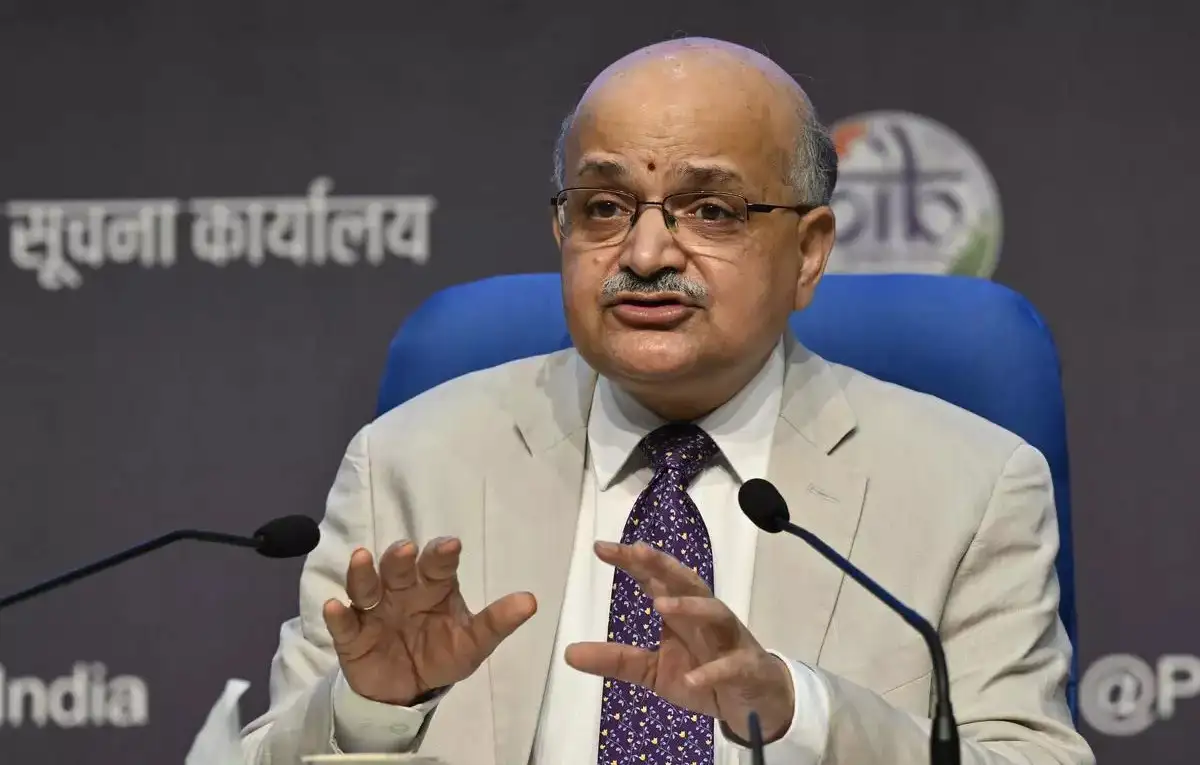
India overtakes Japan to become the fourth largest economy in the world, Aayog CEO BVR Subrahmanyam has said.
Subrahmanyam says the overall geopolitical and economic environment is favourable to India. “We are the fourth largest economy as I speak. We are a USD 4 trillion economy as I speak,” he said.
Citing International Monetary Fund (IMF) data, Subrahmanyam said, India today is larger than Japan. Till 2024, India was the fifth-largest economy in the world. “It is only the US, China and Germany which are larger than India, and if we stick to what is being planned and what is being thought through, in 2.5-3 years, we will be the third largest economy,” Subrahmanyam said.
In a historic economic milestone, India has officially surpassed Japan to become the fourth-largest economy in the world, according to a statement released today by B.V.R. Subrahmanyam, the Chief Executive Officer of NITI Aayog, India’s top public policy think tank.
Subrahmanyam confirmed the development during a policy summit in New Delhi, citing updated data from global financial institutions and India’s Ministry of Finance. The news marks a significant shift in global economic power and underscores India’s rapid growth trajectory amid a challenging international environment.
“India’s economic transformation is no longer a forecast — it’s a reality,” said Subrahmanyam. “We are now the fourth-largest economy, overtaking Japan in terms of nominal GDP. This is a testament to the resilience of our people, the reforms by our government, and the confidence the world has in India’s future.”
A Major Milestone in India’s Economic Journe
India’s rise has been fueled by robust domestic demand, a thriving technology sector, ongoing infrastructure investment, and a growing working-age population. According to the International Monetary Fund (IMF) and World Bank, India’s nominal GDP has reached approximately $4.4 trillion, narrowly edging out Japan’s economy, which is facing slower growth and demographic decline.
Just a decade ago, India ranked seventh globally. The journey to fourth place involved sustained annual GDP growth rates averaging 6–7%, despite global disruptions such as the COVID-19 pandemic, the Ukraine conflict, and rising commodity prices.
What’s Driving the Growth?
India’s economic ascent is attributed to several key drivers:
- Manufacturing Push: Initiatives like ‘Make in India’ and Production-Linked Incentives (PLI) have boosted domestic manufacturing.
- Digital Transformation: India’s fintech and digital services have revolutionized payments and access to government services, creating one of the world’s largest digital economies.
- Start-up Ecosystem: With over 100 unicorns, India is now home to one of the most vibrant start-up ecosystems globally.
- Demographic Advantage: Over 65% of the population is under 35, providing a massive labor and consumer base.
- Economic Reforms: Landmark reforms such as GST, the Insolvency and Bankruptcy Code, and labor law modernization have improved the ease of doing business.
Global Reaction and Strategic Implications
International observers view India’s economic rise as a rebalancing of global power. With China remaining the second-largest economy and the U.S. still in the lead, India’s jump over Japan — once Asia’s economic powerhouse — represents a broader shift in regional influence.
Haruhiko Kuroda, former Governor of the Bank of Japan, remarked during a recent panel discussion, “India’s growth story is real and sustainable. Japan must now rethink its economic structure and invest in innovation and immigration.”
Meanwhile, the United States and European Union have reiterated their commitment to expanding strategic and trade ties with India, recognizing it as a key global growth engine in the coming decades.
Next Target: Germany
With Germany currently holding the third-largest economy slot (nominal GDP around $4.8 trillion), experts believe India could overtake it within the next 2–3 years if current trends continue.
“India’s ambition to be a $5 trillion economy is within striking distance,” said Dr. Arvind Panagariya, economist and former Vice-Chairman of NITI Aayog. “Surpassing Germany is not just symbolic — it will reshape global economic forums like the G7, G20, and BRICS.”
Challenges Ahead
Despite the milestone, experts caution that inequality, urban-rural divide, job creation, and climate resilience remain key challenges.
“Growth must be inclusive,” Subrahmanyam emphasized. “We’re pushing for ‘Viksit Bharat 2047’ — a developed India by our 100th year of independence. But it must be sustainable, equitable, and innovative.”
India’s emergence as the fourth-largest economy in the world is not just a statistical achievement — it is a signal to the world that a new era of Indian influence has begun. As the nation continues to rise, the global economy will increasingly pivot toward South Asia.